The Fundamentals Are Still the Same: What Darren and I built at Elemental Creative in 2002 and what it tells us about GEO, AEO and AI SEO today.
I have been trying to get my head back into work mode, just reading different articles, and I noticed there seems to be this proliferation of new terms around AI and SEO; GEO, AEO, SXO, AI SEO… and it got me thinking.
Maybe it’s because, at the moment, I’m still pretty overwhelmed by Darren’s passing and perhaps my business brain isn’t working quite as well as it normally does, but even I found myself starting to get confused when I was trying to remember which one meant what. If I’m struggling to remember all these different phrases, what must it be like for the ordinary business owner?
I kept reading through all these articles and it suddenly struck me that a lot of the things people are talking about now are actually things that Darren and I were saying when we set up our agency, Elemental Creative. We just used different words.
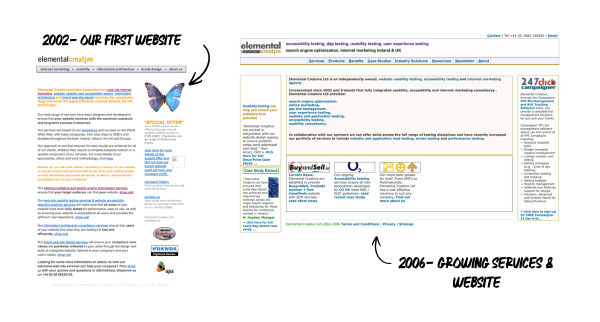
So I went onto the Wayback Machine to find the first version of the Elemental Creative website, which was archived in September 2002. What surprised me wasn’t how old fashioned it looked, it was how much of what we were talking about back then still holds up remarkably well today (Obviously we weren’t talking about AI. AI search simply didn’t exist).
But the principles were still the principles. It was really interesting to go back and look at what we said then, and compare it with where the industry is now.
Back in 2002, Google was still relatively new. It had only been around for a few years and my first memories of it was when Yahoo used its search technology. Online advertising was in its infancy. Banner advertising was everywhere and pay-per-click advertising was incredibly cheap. In fact, I can remember a time when it was almost considered bad form to pay for traffic. SEO was very much about getting somebody onto the first page of Google and, looking back, it all seemed much simpler.
When Darren and I set up Elemental Creative we had a very simple mantra. Our job was to get people to your website through SEO, and then make sure that website actually worked through usability, accessibility, branding and user experience.
We spent a huge amount of time educating businesses about what SEO actually was, what user experience was and why usability mattered. We hit a lot of brick walls. Many businesses simply didn’t understand that there was value in investing in these things. At times people probably thought we were complete crackpots. I remember being told I must have been doing some sort of black magic in regards to SEO!
Darren was regularly told he was wrong about how websites should work, only to see those same recommendations quietly implemented a few weeks later. Sometimes we’d come across businesses whose ego was bigger than their website. If you pointed out that something on the site wasn’t working properly, they took it personally. They thought you were criticising them. We weren’t.We were trying to help them.
I remember one client reading one of our reports and then ripping it up in front of us because they were so insulted by what we’d written (I should probably add that anyone who has ever seen our reports will know they were incredibly professional, very technical and based entirely on research). The funny thing was that a few weeks later they’d implemented almost every recommendation we’d made.
As I started looking through our old website, I found myself smiling because all these things we’d been talking about back then are exactly the sort of things people are talking about today.
SEO, Information Architecture, Usability Testing, Accessibility, Brand Design. They were all important elements of what we did. When I look through each one of those pages now, they’re talking about exactly the same invisible elements that make a website work.
We knew that structure mattered. We knew how important it was that information was laid out properly. We knew that getting someone from A to B, allowing them to complete whatever task they’d come to the website to do, was one of the most important parts of the whole process.
For us, it was never all about SEO. It wasn’t about shoving loads of words onto a page. It was about sitting down and working out exactly what a website should contain, how the information should be organised and how someone should move through that website to complete the process they came there to do.
Good usability is invisible. People don’t notice good usability. They notice bad usability.
When I look at today’s terminology, people talk about semantic search, topic clusters, GEO and all these different phrases. Back then we simply called it Information Architecture.
The same thing happened when I looked at our pages on usability and accessibility. We knew how important it was that a website actually worked. If someone spent money on a website, they should get enquiries, sales, visitors or whatever it was they were measuring. Websites exist for users. They’re there to help people complete a task. That means making sure the navigation is clear, the information is easy to understand and the customer doesn’t become frustrated.
Today people talk about SXO, UX, CRO and Core Web Vitals. Again, they’re all really important. But they’re built on exactly the same foundations.
Accessibility was another interesting one. It was actually quite a difficult thing to sell because, in my experience, many businesses tend to be reactive rather than proactive.
We spent a lot of time explaining why accessibility mattered and why websites should be built for everybody. Believe it or not, there were people who actually disagreed with us.
I remember sitting with one potential client who said, “We don’t care about accessibility. If people have accessibility issues, we don’t want them on our website.” We politely declined the work.
Today accessibility forms part of user experience and overall website quality. Back then it was simply something we believed was the right thing to do. Again, the principles haven’t changed.
The other thing that really struck me was branding. Back then we talked about brand values and what a company’s brand represented. Today people talk about brand authority, entities, E-E-A-T and trust signals. Again, they’re all valid concepts. They’re just modern names for things that people been discussing for years.
So what would I say has really changed? We’ve now got AI search, ChatGPT, Google’s AI Overviews, zero-click searches, voice search, structured data, and search has become much more conversational. There are a lot of new things happening in the world of SEO and UX.
But what hasn’t changed is that you still need to understand your customer. You still need to solve real problems. Information still needs to be where the user expects to find it.
People buy from businesses they trust. That hasn’t changed either. You need to make yourself an authority in your field and earn that authority, whether that’s through links from respected websites, articles, recommendations or simply by consistently creating useful content.
Websites still need to be easy to use. Going back to what we believed twenty-four years ago, I honestly don’t think that’s changed at all. Quality content still matters. Not boring people with huge articles for the sake of it, but creating content that’s genuinely useful. Ultimately, a website has to deliver value.
Whatever the objectives of that website are, whether it’s enquiries, sales, bookings or simply getting people to pick up the phone, it should help achieve those objectives.
The technology has changed. The language has changed. The principles really haven’t.
So what would my advice be to businesses? If somebody asked me, “With all these new terms and all these changes, what should I actually do now?”
My answer would be very simple. Focus on the things that have always mattered.
Know your audience.
Build authority.
Create genuinely useful content.
Structure your website properly.
Think long term.
Keep your branding consistent.
Most importantly, make your website easy to use.
Those were the things we believed in back then, and I honestly don’t think they’re any less relevant today.
Looking back through all of this has been unexpectedly emotional. Darren and I both discovered the internet at exactly the right time. By complete chance, we both became fascinated by it. The idea that you could actually build a business around something you genuinely loved doing was mind-blowing to both of us. We really were two pieces of the same jigsaw.
I was always fascinated by SEO, digital marketing and understanding how people thought. Darren loved making websites work.
Looking back over something we wrote twenty-four years ago reminded me that, although technology has moved on and the terminology has changed, some ideas really do stand the test of time. The thinking behind our work wasn’t created in isolation. It was shaped by people like Jakob Nielsen , Barry Lloyd , Steve Krug, Danny Sullivan and many others whose work influenced a generation of web designers and SEO professionals.
AI is obviously evolving, and people will continue to develop new ways of describing it and working with it, and that’s absolutely fine. But I don’t think AI has rewritten the rules of SEO.
Back in 2002 we built websites for people and search engines.
Today, in 2026, we’re building websites for people, search engines and AI.