Why Your Website Gets Impressions But No Clicks
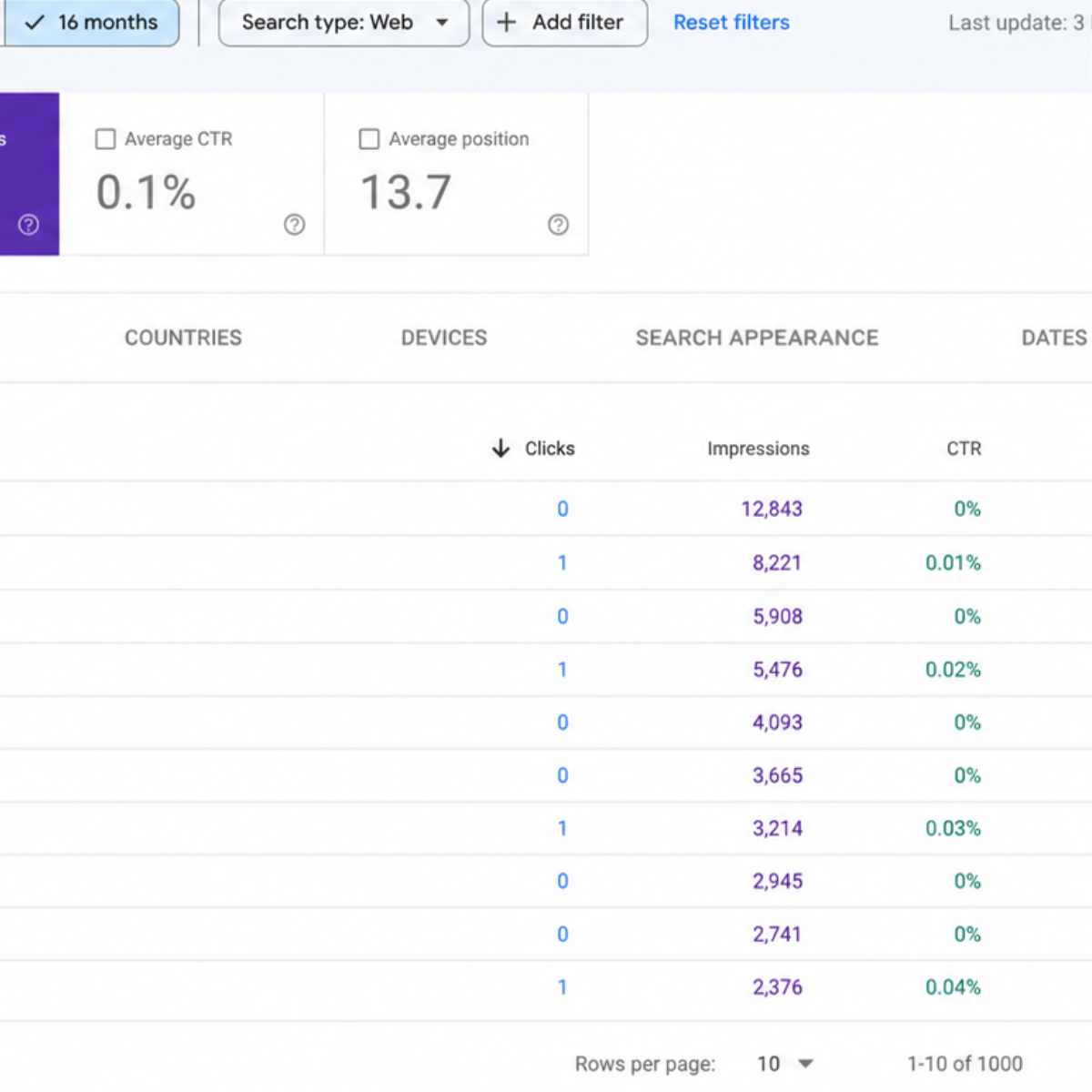
Google Search Console shows you are appearing in search results. The impressions column has numbers in it. The clicks column, for the most part, does not.
This is not a rare edge case. It is the situation most Northern Ireland businesses find themselves in when they look at their data properly for the first time.
The following explains the specific reasons it happens, what the data actually tells you, and what changes make a practical difference. The examples used come from real Search Console data on this website.
What the Impression Count Is Actually Telling You
An impression is recorded when your URL appears in a set of search results, whether the person scrolling ever reaches your listing or not. A result at position 45 gets an impression every time it loads, even though almost nobody scrolls that far.
This matters because a high impression count does not mean thousands of people looked at your listing and decided against clicking. Many of those impressions were recorded at depths in the results where clicks are statistically close to zero regardless of how good the listing looks.
The search term ‘search engine positioning’ generated 3,394 impressions for advanseomarketing.com over a three-month period. Zero clicks. The average position was 13 — the bottom of page 1 or top of page 2 depending on the device. At that position, even a well-written title tag will produce a very low click-through rate. The volume of impressions looks significant. The actual reach is not.
The Specific Reasons Clicks Do Not Follow Impressions
Position is the dominant factor
The relationship between position and clicks is not linear. It drops sharply. The top result on a search page typically receives somewhere between 25% and 35% of all clicks for that query. By position 5, that figure is usually below 7%. By position 10, it is below 3%. Below position 10, click-through rates are fractional for most search terms.
‘Seo consultant belfast’ shows 29 impressions at an average position of 14. That position, for a commercial search term where the person is actively looking to hire someone, produces almost no clicks regardless of what the title tag says. The listing is visible in a technical sense. It is not competitive.
The queries that matter most for a service business are not the high-volume informational ones. They are the lower-volume, higher-intent searches where someone is ready to act. Those need to rank in the top five to generate traffic reliably.
The title tag and meta description are not doing enough work
When someone scans a page of search results, they are making a fast decision based on the title and the two lines of description beneath it. If those lines do not match what they were searching for, or do not give them a reason to click your result over the ones above and below it, they move on.
Most businesses write their title tags once during a site build. They tend to look like ‘Services | Company Name’ or a variation on it. At position 8, where there is genuine competition for clicks, that kind of title loses to one that includes a specific location, a credential, or a clear offer.
‘SEO Consultant Belfast | 20 Years Experience | Free Consultation’ will outperform ‘SEO Services | AdvanSEO’ at the same position, because it answers three questions the searcher has: who, why them, and what is the first step.
The page does not match what the searcher was looking for
Google indexes pages based on their content, but it ranks them based on how well they serve search intent. A page written as a general introduction to SEO will rank differently to a page written for someone who wants to hire an SEO consultant. Both might contain similar keywords. Only one answers the query.
The advanseomarketing.com/search-engine-positioning/ page generated 4,347 impressions over three months at an average position of 14.7. It is an informational page. People landing on it from search are likely looking for an explanation, not a service. That disconnect between content type and searcher expectation limits both clicks and conversions.
Looking at what ranks on page 1 for a target query tells you what Google considers the right content type for that search. If the top results are all service pages and yours is a blog post, or vice versa, the mismatch is likely contributing to low click-through rates.
Google is providing the answer on the results page
Since 2023, Google has placed AI-generated summaries at the top of results for a growing proportion of searches. These AI Overviews pull information from multiple sources and present a direct answer without requiring the user to click anywhere.
The practical effect is that a page can rank at position 1, appear in thousands of searches, and receive almost no clicks because the search has already been resolved above the organic results.
Three search terms — ‘seo belfast’, ‘seo services belfast’, and ‘belfast seo’ — show average positions of 1.0 in Search Console for advanseomarketing.com. All three have zero clicks. An AI Overview is appearing above those organic results and answering the query before anyone reaches the ranked pages.
The same pattern is emerging through ChatGPT and Perplexity, which synthesise answers from web content without sending referral traffic to the sources they draw from. Search Console does not capture this traffic loss because it only tracks Google searches.
This is not a problem that title tag optimisation or better content structure will fix on its own. The response to zero-click search is different to the response to low click-through rates from poor rankings, and the two are frequently confused.
How to Read Your Own Search Console Data
Open Search Console and go to Search Results. Filter by query rather than page. For each query with meaningful impressions and near-zero clicks, note the average position and then manually search that term in an incognito browser window.
If an AI Overview appears above the organic results, that is your answer for why clicks are low regardless of position. If no AI Overview appears and your listing is in the top five, the issue is more likely the title tag, meta description, or page content. If your position is below 10, position improvement is the priority before anything else.
These are three different problems with three different solutions. Treating them as one and applying the same fix to all of them produces limited results.
What Produces Actual Improvement
For pages ranked between positions 11 and 30
These are the pages closest to producing clicks. A page at position 18 for ‘seo consultant northern ireland’ is one content and authority improvement away from page 1. Deeper content, better internal linking from related pages, and clearer relevance signals for the specific query tend to produce movement within a few weeks for pages already in this range.
For a commercial print business in Northern Ireland, that kind of focused page-level work on underperforming but close-to-ranking pages contributed to a 573% increase in organic traffic over the course of the engagement. The starting point was identifying which pages were closest to breaking into the top 10, not starting from scratch.
For weak title tags and descriptions
Rewrite them based on the specific query you want the page to rank for, what the page actually delivers, and what differentiates your result from the competition at the same position. Test one page at a time and monitor the change in CTR in Search Console over the following four weeks. This is a low-cost change with a measurable outcome.
For intent mismatch
Either restructure the existing page to match what the searcher wants, or create a separate page that serves that intent directly. A single page trying to rank for an informational query and a commercial query at the same time rarely performs well for either.
The search engine positioning page on advanseomarketing.com has high impressions but low clicks and low conversions. The page serves people looking for an explanation of a concept. Changing it to target someone looking to hire an SEO consultant would likely reduce impressions but increase both clicks and enquiries from the traffic it does receive.
For zero-click AI searches
The goal shifts from capturing the click to appearing within the AI-generated answer. Google pulls content into AI Overviews from pages it considers authoritative on the topic, clearly structured, and directly relevant to the query. Pages that answer a specific question concisely, use clear headings, include accurate data, and are technically accessible to crawlers tend to appear more frequently in AI Overviews than pages optimised purely for traditional keyword ranking.
Schema markup, content freshness, and crawl accessibility all influence this. For ChatGPT and Perplexity, the signals are somewhat different; these tools weight different authority markers and respond to different content structures. Appearing in AI-generated answers across multiple platforms requires understanding how each one selects and uses source content.
This is not speculative. The first click recorded on the advanseomarketing.com Google Ads campaign came from the search term ‘seo for ai search’. That query exists because business owners and marketing managers are actively looking for someone who understands this specific problem.
The Relationship Between Organic Impressions and Paid Search
If organic results are generating impressions but not clicks, a Search campaign targeting the same commercial queries captures traffic that organic alone is not converting. This is not a substitute for improving organic performance, but it addresses the short-term gap while longer-term work takes effect.
The queries where advanseomarketing.com has organic impressions but low click-through rates — ‘seo consultant belfast’, ‘seo agency belfast’, ‘seo services northern ireland’ — are exactly the terms the paid campaign targets. The paid ads appear above the organic results and above the AI Overviews, which means they reach the searcher before either of the factors limiting organic clicks comes into play.
The Practical Starting Point
Pull your Search Console data for the last three months. Sort by impressions. For the ten queries with the highest impression counts and lowest click-through rates, run the three-point check: what is the average position, does an AI Overview appear for that term, and does the page match what the searcher wants.
That will tell you which problem you actually have and which fix applies.
If you want that analysis done on your site rather than working through it yourself, a structured SEO audit covers search visibility, technical health, keyword gaps, and competitor activity and produces a prioritised list of what to address first.
Find Out What Is Holding Your Site Back
An SEO and website audit covers your technical health, search visibility, keyword gaps, and competitor activity. You get a prioritised list of what to fix first. Find out what an audit covers.
FAQs
The most common reasons are ranking position below the top five, a title tag or meta description that does not give searchers a reason to click, a mismatch between page content and search intent, or an AI Overview appearing above your result and answering the query without requiring a click.
A zero-click search is one where Google provides the answer directly on the results page, through an AI Overview, featured snippet, or knowledge panel, so the searcher does not need to click through to any website. The website still receives an impression but no click.
Start by identifying which queries have high impressions and low clicks. Check whether an AI Overview appears for those terms. For queries below position 10, improving the page content and authority is the priority. For queries in the top five with low CTR, rewriting the title tag and meta description to better match the search intent usually produces the clearest improvement.
Yes, for informational queries where Google can synthesise a direct answer, AI Overviews reduce click-through rates to organic results. Pages that previously ranked at position 1 for certain queries are now receiving significantly fewer clicks than they did before AI Overviews were introduced.