
SEO Case Study: How an Established B2B Website Increased Engagement by 44%
This site was already attracting strong traffic. The challenge was not building from scratch, but making what was already there work harder: better engagement, stronger search alignment, and a more balanced channel mix.
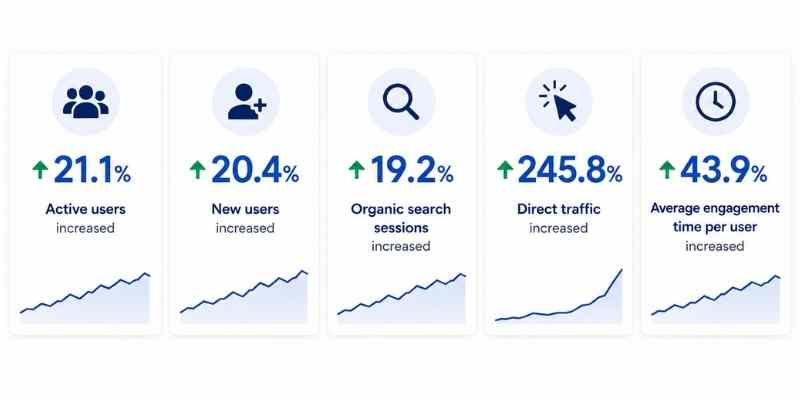
At a Glance
| Metric | Year-on-Year Result |
|---|---|
| Active users | +21.1% |
| New users | +20.4% |
| Organic search sessions | +19.2% |
| Direct traffic | +245.8% |
| Average engagement time per user | +43.9% |
+246%Direct traffic growth, signalling stronger brand recognition
+44%Longer engagement time per user across the site
Why these numbers matter: On a site that was already generating high traffic volumes, percentage improvements represent a significant real-terms increase in users, sessions, and engagement. Growing an established site by 20% is a fundamentally different challenge to growing a new one by 500%.
The Business
The client operates an established B2B website that was already performing well in terms of raw traffic numbers. The site had a solid foundation, an existing audience, and a track record of attracting visitors.
The issue was not a lack of traffic. It was that the traffic was not working as efficiently as it could. Growth had plateaued, engagement was inconsistent, and the business had limited visibility into what was driving performance and where the opportunities were.
What Was Holding It Back
This was not a broken website. It was an underoptimised one. The difference matters, because the approach needed to be targeted refinement rather than a ground-up rebuild.
Growth had flattened. The site was attracting consistent traffic, but the numbers had stopped climbing. Without changes to content, structure, or keyword targeting, the site had reached a natural ceiling within its existing setup.
Engagement was low relative to traffic. Visitors were arriving, but too many were leaving quickly or not interacting with content beyond the landing page. This suggested a gap between what users expected to find and what the pages were delivering.
Over-reliance on a narrow channel mix. The traffic source breakdown showed a heavy dependence on a small number of channels. There was room to strengthen organic search and direct traffic as more sustainable, long-term sources.
Analytics was not being used to guide decisions. Data was being collected, but it was not being translated into action. Page-level performance, user behaviour patterns, and traffic source shifts were not being monitored in a way that could inform content updates or structural changes.
What I Did
Performance Audit and Opportunity Mapping
I started with a detailed review of how the site was performing across traffic sources, user behaviour, and individual page metrics. This was not a standard technical audit. The site’s foundations were sound. The focus was on identifying where existing pages were underperforming relative to their potential, where search intent was not being met, and where small structural changes could unlock meaningful gains.
Content Refinement Aligned to Search Intent
High-traffic pages were reviewed to assess how well their content matched what users were actually searching for. In several cases, pages were ranking and attracting clicks but not delivering the information users expected, which was hurting both engagement and conversion.
Content was updated to close these gaps: headings were restructured, body copy was expanded or tightened to better address user intent, and keyword targeting was refined to capture more relevant queries without losing existing rankings.
Internal Linking and Site Structure
The internal linking structure was reviewed and improved to create clearer pathways between related content. This served two purposes: helping users find relevant pages more easily (improving engagement and time on site) and helping search engines understand the relationship between pages (supporting stronger indexing and ranking signals).
Data-Led Iteration
This was not a one-off project. Changes were made incrementally, guided by performance data at each stage. Rather than making sweeping changes and hoping for the best, I used analytics to identify what was working, what needed further adjustment, and where new opportunities were emerging. This iterative approach meant the work built on itself, with each round of improvements informed by the results of the last.
Analytics Mentoring
Alongside the implementation work, I helped the business develop a clearer understanding of its own analytics. This included how to identify meaningful shifts in traffic patterns, how to read engagement data at a page level, and how to use performance trends to guide future content and SEO decisions.
The Results
Comparing year-on-year performance, the site showed consistent improvement across every key metric.
Active users grew by 21.1% and new users by 20.4%, both significant on a site that was already attracting high volumes. Organic search sessions increased by 19.2%, confirming that the keyword and content work was driving more relevant search traffic.
The most notable shift was in direct traffic, which grew by 245.8%. This is a strong signal that brand recognition and recall are improving. People are not just finding the site through search; they are coming back to it directly.
Average engagement time per user increased by 43.9%. This is arguably the most important metric in this project, because it confirms that the content changes were not just attracting more visitors but keeping them on the site longer and giving them more of what they were looking for.
What This Meant for the Business
The site moved from a position of steady but stagnant performance to one of active, measurable growth. Traffic is not just higher; it is better quality. Users are staying longer, engaging more, and arriving through a healthier mix of channels.
The growth in direct traffic is particularly significant for a B2B business. It indicates that the brand is becoming more recognisable and that existing contacts, referral partners, and repeat visitors are returning to the site with purpose rather than arriving passively through search alone.
The business also now has a much clearer picture of how its website performs. Analytics is being used as a practical tool for decision-making, not just a dashboard that gets glanced at occasionally. This means future improvements can be prioritised based on evidence rather than assumption.
For an established site, this kind of incremental, data-led improvement is often more valuable than dramatic overhauls. The gains compound. Each improvement creates a stronger foundation for the next, and the business retains control of the process because it understands what is happening and why.
Services Used in This Project
- Website & SEO Audits: Performance audit focused on identifying untapped potential across existing pages and traffic sources
- On-Page SEO: Keyword refinement, content updates, and heading restructuring aligned to search intent
- SEO Copywriting & Content Marketing: Targeted content improvements on high-traffic pages to improve relevance and engagement
- SEO Training & Mentoring: Ongoing support to help the business read, interpret, and act on its own analytics data
Already Getting Traffic but Not Seeing Growth?
If your website has a solid foundation but performance has plateaued, the opportunity is usually in refinement, not rebuilding. A targeted audit can show you exactly where the untapped potential sits and what to prioritise next.Book a Free SEO Consultation